 BusinessTech Academy
Santa Fe High School
BusinessTech Academy
Santa Fe High School
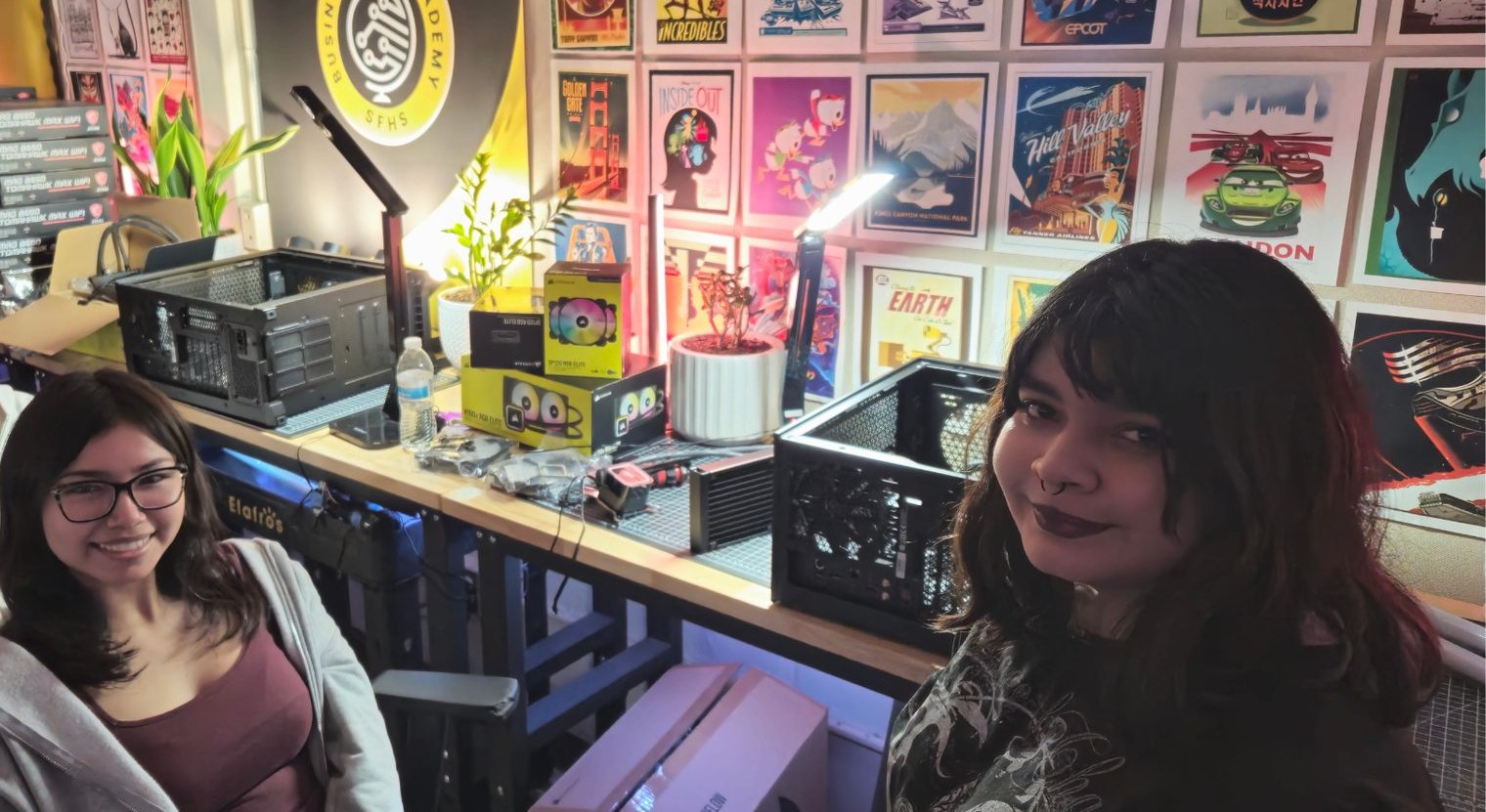
At the build bench
 Why BusinessTech Academy
Make
real things
Most classes end in a grade. This one ends in work you can show someone — an analysis, an ad, a game people play, a thing you built, an organization you ran.
Five things students made
Wearables, hardware and soft circuits, made in class and worn out of it. Three of these everyone does — a game sophomore year, a PC junior year, a saber senior year. The rest are projects individual students took on.
The one that ends the year
Seniors finish on the bench, and this is what they finish with.
Lightsaber
A 3D-printed hilt set with rhinestones by hand, a board and screen mounted on the emitter, and a lit blade running off it. Seniors finish on the bench, and this is what they finish with.
Boards you sew in, and wear out
Programmed in class, stitched into something you take with you.
LED caps
Boards mounted on the crown, programmed in class and worn the same afternoon.
Light-up bear
A round board stitched into the chest of a plush toy, lighting the fur from the inside.
LED gown
Addressable LED strips run the length of the skirt, each panel driven by its own microcontroller sewn into the hem.
Desktop builds
Cases, cooling and cable runs assembled on the bench, one machine per team. These stay in the room — the machines are the room’s, not yours to carry out.
What you actually do here
You work real data, not practice data.
Live public records from real cities — sanitation and health complaints in San Francisco, 311 rat sightings in New York, county data in Los Angeles. The same sources a working analyst uses. Nobody made these numbers up for a worksheet, and real data does not come clean. Learning that is most of the lesson.
See the investigationsYou get total creative control.
You pick the product, write it, shoot it, and cut it yourself — thirty seconds, start to finish. Then you defend the choices you made. Nobody hands you a storyboard.
Watch the adsYou ship software people use.
Games written in class, playable in the browser, on the open web with your name on them. Not a screenshot of a project, and not a demo that only runs on the machine you built it on. The thing itself, running, for anyone.
Play the arcadeYou build hardware you can wear out of the room.
Soft circuits, addressable LEDs, microcontrollers sewn into a hem, boards stitched into a plush toy, desktop machines assembled on the bench one per team. Programmed in class and worn the same afternoon.
See what students madeYou can run the place.
The Academy is governed by a student Board with written bylaws — a President, two Assistant Directors, and a general board with real domains. Students set the calendar, run the fundraisers, own the brand, and hold the culture. Sophomores can join in September.
How the Board worksYou learn to argue, on the record, with a role.
Seminars run on a protocol, not on whoever is loudest. Every student takes a role at the table and the roles rotate — one opens, one builds on what came before, one pushes back, one brings in whoever has not spoken yet. Your position is written down before you speak, and everyone speaks before anyone speaks twice.
WorkKeep both hands on the work
You are not choosing a set of classes. You are choosing what you walk out holding.
Information Systems I
The first course. Information systems and business management, emotional literacy, and the habits of a professional.
Information Systems II
Project-based work and case studies — ethics, project management, product failure, branding, marketing, risk.
Information Systems III
The senior course. Digital product creation, data analysis and the seminar table, carried to a finished piece of work.
You arrive as a mentee. You leave as a mentor.
That is not a slogan here, it is the schedule. Academy officers carry two periods: their own course, and a mentorship period in a lower Academy course. New members are handed to a named peer on day one, never left to attach to an adult. The President graduates each spring and a rising Assistant Director steps into the chair.
Colleges and employers can read the difference between someone who took the class and someone who ran the room.
One instructor teaches the whole sequence.
The same person teaches Exploring Computer Science in ninth grade and the senior capstone three years later. The GIS specialty is a master’s field, taught by someone who spent fourteen years building software before teaching it.
Qualifications
Before the classroom
Department Chair for career technical education at Whittier Union High School District since 2024, and the Academy’s instructor since 2019.
The Board is described everywhere on this site. Here it is in writing.
Students wrote and ratified both of these, and they are what the Board is held to.
This is a technology academy, and part of your work is learning to use tools well — including AI. It is a legitimate tool for brainstorming, research, drafting, feedback, and debugging, when you disclose it and can stand behind and explain your work.
It is not acceptable to submit AI-generated work as your own, to use it where an assignment prohibits it, or to use it to skip the learning an assignment is built to develop. Be ready to show the process.
Using a tool to think is OK. Using one to avoid thinking isn’t.
Half of this is not the computer. It is writing, arguing, selling, drawing, sewing, filming, cooking, running an event floor, and standing up in front of people. The students who do best here are usually the ones who were not sure they belonged in a tech program.
And a quiet student is not left to sink. Every seminar table assigns one person the job of bringing in whoever has not spoken yet.
Open year round
There is no single deadline to miss. If you are interested in the middle of a semester, that is a fine time to say so.
Sophomores and juniors at Santa Fe High School
You do not need a background in business or technology, and you do not need to have decided on a pathway yet.
Any time in the year
We take interest forms year round. Put yours in when you are ready rather than waiting for a window to open.
You interview
There is an interview, so we can meet you and you can ask us anything you want to know before you commit a year to this.
Start in Exploring Computer Science
Freshmen who take Mr. Chesher’s Exploring Computer Science in ninth grade come in with an advantage — same instructor, a year of the work already behind them.
Come see it before you decide. The Academy is out in public at Club Rush, Back-to-School Night, Future Freshmen, Freshman Orientation, and the Career Fair. Students run all of it. Talk to them, not to a brochure.
Or write to director@sfhsbta.com
This is a California Partnership Academy
Not a club and not an elective. A California Partnership Academy is a state program in California Education Code, and the Academy is one: a three-year, grades ten to twelve course of study run as a school within a school, with the same cohort of students and the same team of teachers for all three years.
“Integrated academic and career technical education” carried by “rigorous academics and career technical education within a career focus, a committed team of teachers, and active business and post-secondary partnerships.”
That is what the seminar table and the Board in this site are — the parts of that model, built out.
Three years, one cohort
Grades ten through twelve, taught as a school within a school by a team that stays with you.
Business and Finance
One of the fifteen industry sectors in California’s CTE Model Curriculum Standards, adopted by the State Board in 2013. Its three pathways are Business Management, International Business and Financial Services.
Partners and mentors
Business partnerships, mentoring and internships are part of the model, not an extra.
What the evidence says
California Partnership Academies are among the most heavily studied programs in American secondary education. In 2024 MDRC published a randomized evaluation — students who applied were assigned a place by lottery, so the groups were alike before anyone walked in the door. These are its numbers.
Against a California average of 86% — and the state requires academies to reserve half their seats for students at risk of not graduating.
College readiness for students who were both economically disadvantaged and struggling academically. Statistically significant.
Academy students were far likelier to hold or expect a real credential in their field before they graduate.
33% straight to a four-year university. 60% finished the a–g courses a California public university requires, against a 50% state average.
The lottery also found a twelve-point gain in college readiness for young women, and academy students were about 21 points likelier to get real work-based learning. They reported more personal attention from teachers, more collaboration, and feeling better prepared for what comes next. Eighty-eight percent took most of their classes with the same people three years running — the small-cohort model doing exactly what it claims.
Where the study found nothing, read it carefullyNo graduation effect
Because both groups graduated at 93%, seven points above the state, with nothing left to move.
Same buildings
79% of comparison students took a CTE course anyway and 36% did work-based learning, so the contrast was never academy against nothing. COVID also cancelled or postponed work-based learning for most of the cohort, which MDRC notes “could dilute the effects of the program.”
The wrong year
MDRC’s landmark career-academy trial found sustained earnings gains across the eight years after high school, without college-enrollment effects. This report is the first of three; the earnings land in 2028 and 2032. We will publish those too, whichever way they go.
An Evaluation of California Partnership Academies: Charting the Path from High School to Postsecondary Enrollment, MDRC, 2024 — overview and impact findings. Statewide comparison figures are the report’s own.
What career technical education actually means
“A program of study that involves a multiyear sequence of courses that integrates core academic knowledge with technical and occupational knowledge to provide students with a pathway to postsecondary education and careers.”
Multiyear sequence
Information Systems I, II and III are one course, taught over three years, not three that happen to share a room.
And
The academic and the occupational are not alternatives here. The point is not to choose between university and a trade; it is to leave with the option of either.
The standards document is the state’s own, hosted here so it opens without hunting for it. Every other link goes to the California Department of Education. Nothing on this page is our description of the program — it is the state’s, and you can check it.