
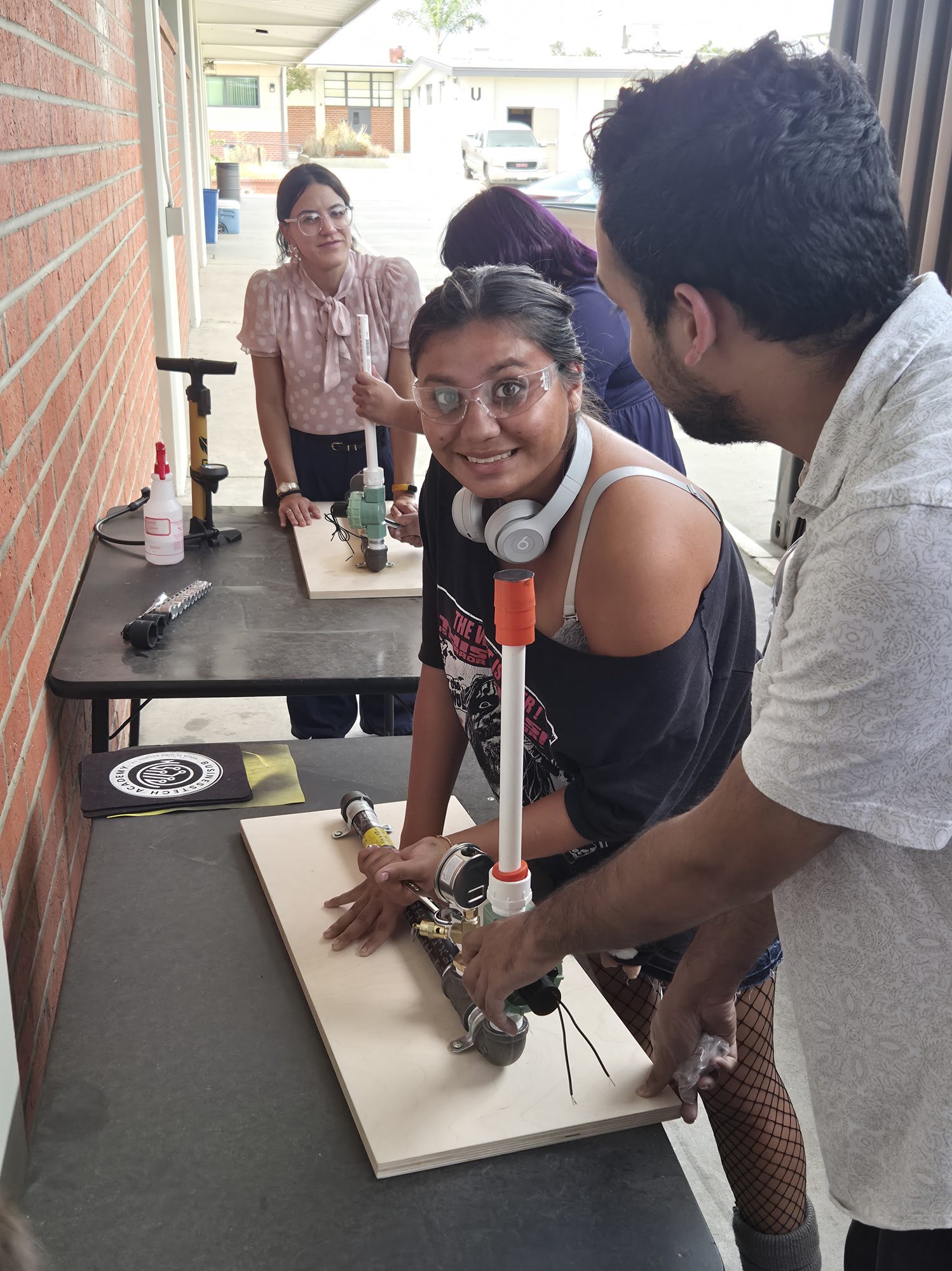
Building a pneumatic rocket launcher
 Young women in the academy
Mentored into a mentor
A board member’s answer to what this is for: empowering young women into future leaders — supported through mentorship, then transformed into a mentor. Everything below is whether the research agrees.
+12pts
Young women in these academies came out ahead on being ready for college — and it was one of the only real differences the study found.
MDRC · California Partnership Academies · 2024 · students chosen by lottery
And it is learned by running the events
The line in the hero is hers. Here it is whole:
“It allows future leaders to be supported through mentorship while also being transformed into a mentor.”
The board prepares and runs the events, and preparing and organising an event is where the problem-solving gets practised — not in a lesson about problem-solving. Her closing line is the claim: the academy lets students take charge, and guides them into being the leaders.
Asked what Women in the Academy is about, answered in writing, quoted as written. One detail worth keeping: she wrote “dedication”, crossed it out, and replaced it with commitment — twice.
Nothing, and then one thing
In 2024 a research group called MDRC studied California Partnership Academies — this same kind of program, in this state. Students had been picked by lottery, the way names are drawn from a hat. That detail is the whole reason the study counts: it means the students inside the program and the students outside it were alike to begin with, so a difference later on is down to the program and not to who chose to sign up.
On the main things it measured, the study found no difference. Graduation: 92.9 percent either way. Going on to college after high school: no real difference. Readiness overall: no real difference.
Then one group moved. Young women in the academies came out twelve points ahead on the study’s measure of college readiness. Researchers call a result significant when it is big enough that plain luck is an unlikely explanation. This one was — and almost nothing else in the report was.
Students who were both low-income and behind in school. A real difference, not luck.
Same study
Fewer students dropped out — and the study says the effect was “more pronounced for females than males.”
Bonilla, California, 2020
The older evidencefavoured young men.
The best-known study of career academies — MDRC again, in 2008, following what students earned for eight years afterwards — found they made about eleven percent more money. But look at who. The gain sat with young men, who earned seventeen percent more, close to thirty thousand dollars over those eight years. For young women, that pay gain was not there.
So the honest answer has two halves. The evidence from outside California, on earnings favoured young men. The two California studies — the 2024 academy study and a 2020 study of students dropping out — both point the other way, toward young women. Nobody has pay data for this model yet. MDRC does not publish it until 2028 and 2032.
We are not saying the question is settled. We are saying that where California has looked, the effect on young women is the one that keeps turning up — and that it turned up in a study that otherwise found nothing.
Read the full evidence reviewWho is actually in the room
Everything above this line is about other people’s students. This part is about ours — and it is not a study. It is our own roster, counting young women in each group. Both sides of the comparison sit in the same building.
Young women, as a share of each group
Same site, same teacher, same year.
One of those groups was built on purpose. The other was not. The computer science class anyone can sign up for runs near thirty percent young women, which is about where the state as a whole sits. Each new Academy group has been more balanced than the one before it.
This is who enrolled, not how they did. And it is our own count, not an outside one — which is exactly why it sits under its own heading instead of with the studies above. It does not prove the academy causes anything. It shows who is in the room. Who is in the room is the one thing those studies cannot tell you about this building.
For scale: CSforCA, a California computer science group, reports that 34 percent of the state’s AP computer science test-takers identify as female or non-binary. That counts a narrower group than all computer science classes, so treat it as a rough reference rather than a direct comparison.
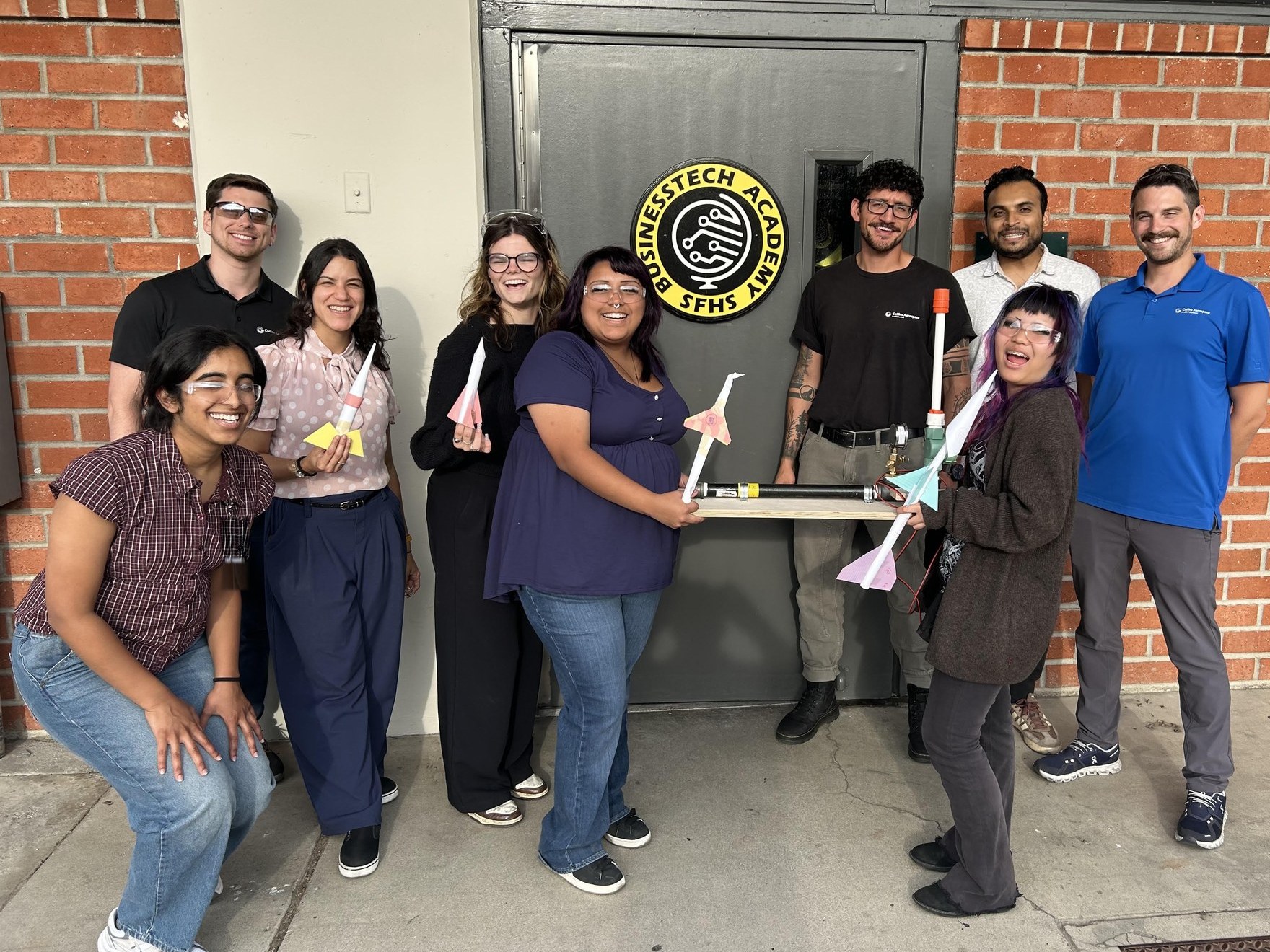
A pneumatic rocket launcher, with Collins Aerospace
Engineers from Collins Aerospace work alongside the academy on the build — laying out the platform, fitting the valve and the pump, driving the fasteners, and working the small parts under a lamp at the bench. The photographs are one afternoon of it.

Where California has looked, this is what it keeps finding
This is built into how the academy runs, not added on top — it shapes who gets appointed, who mentors whom, and the path into the President’s chair.